
How to write a credit dispute letter for genuine report errors
A useful dispute starts with one specific error, a clear explanation and documents that support your facts—not a promise to erase negative information.
A credit dispute letter asks a credit reporting company to investigate information you believe is inaccurate or incomplete. You can dispute errors yourself for free. A letter does not guarantee a removal, a score increase or a particular outcome.
First, identify a genuine credit report error
Not sure whether an entry is wrong? Use our checklist for identifying genuine credit report errors to compare identity details, account status and balances with your records.
Read the account entry and compare it with your own records. Possible errors include a payment marked late when it was paid on time, an incorrect balance, or another person’s account appearing in your file. A negative entry is not necessarily an error simply because it hurts your credit.
- Get your reports. Use AnnualCreditReport.com, the official site for free reports from the nationwide credit reporting companies. Check which report actually contains the issue.
- Pinpoint the entry. Record the reporting company, account name, account number as shown on the report, report date and the exact field you believe is wrong.
- Match it to evidence. Gather relevant statements, payment confirmations or correspondence. Highlight the relevant report entry and keep your originals.
If an unfamiliar account may involve identity theft, visit IdentityTheft.gov for a recovery plan. Identity theft can require additional reporting and a different process from an ordinary accuracy dispute.
What to include in your credit dispute letter
The Consumer Financial Protection Bureau (CFPB) recommends identifying yourself, explaining each disputed item and including copies of supporting documents.
- Your full name, mailing address and telephone number.
- Your report confirmation number, if available, and enough account detail to identify the disputed entry.
- What the report says, why you believe it is wrong and the accurate information supported by your records.
- A specific request to investigate and make the appropriate correction.
- A copy of the relevant report section and copies—not originals—of supporting evidence.
Follow the recipient’s current identity-verification instructions. Send sensitive documents only through its official dispute channel; do not post account details or identification in a public comment or ordinary contact form.
Credit dispute letter example: a payment incorrectly marked late
Illustrative scenario: your report lists a payment as 30 days late, but your statement and payment confirmation show the payment was received by the due date. Use this example only if it reflects your actual facts. Replace every bracketed detail before sending it.
[Your full name]
[Your mailing address]
[City, state, ZIP]
[Telephone number]
[Date]
[Credit reporting company]
[Current official dispute mailing address]
Re: Dispute of inaccurate payment history
Report confirmation number: [if available]
Account: [Creditor name and account number as shown on report]
To whom it may concern:
I am disputing the payment status for [month and year] on the account identified above in my credit report dated [report date]. The entry shows a payment that was 30 days late.
I believe this is inaccurate because the payment of [amount] was received on [date], on or before the due date of [date]. I have enclosed a copy of [statement or payment confirmation] showing the due date and payment receipt, along with the relevant report page with the entry highlighted.
Please investigate this payment status and correct the entry to reflect the accurate payment history supported by the enclosed records. Please send me the investigation results and an updated report if a correction is made.
Sincerely,
[Your name]
Enclosures:
• Highlighted credit report page
• [Statement showing payment due date]
• [Payment confirmation showing receipt date]
• [Identity/address documents required by the recipient, if applicable]
This is an example, not an allegation about any particular company. Do not claim a payment was on time unless your records support that claim. If the facts are different—for example, the balance is incorrect—describe those facts and request the corresponding correction instead.
Where and how to send your dispute
Send the dispute to each credit reporting company whose report contains the error. Use its current official mailing address or online dispute portal; the CFPB’s guide links to Equifax, Experian and TransUnion’s current instructions. Do not assume an address in an old template is still correct.
You can also dispute the information with the company that supplied it, called the furnisher—for example, your lender. Use the dispute address on your report or the address the furnisher specifically designates for credit reporting disputes. Adapt the letter to that recipient.
If you mail the letter, certified mail with a return receipt can help you document when it arrived. Keep a copy of the complete packet and delivery record. For an online dispute, save the submission confirmation and copies of the documents uploaded. Mailing costs are separate from your right to dispute for free.
What to do after sending your letter
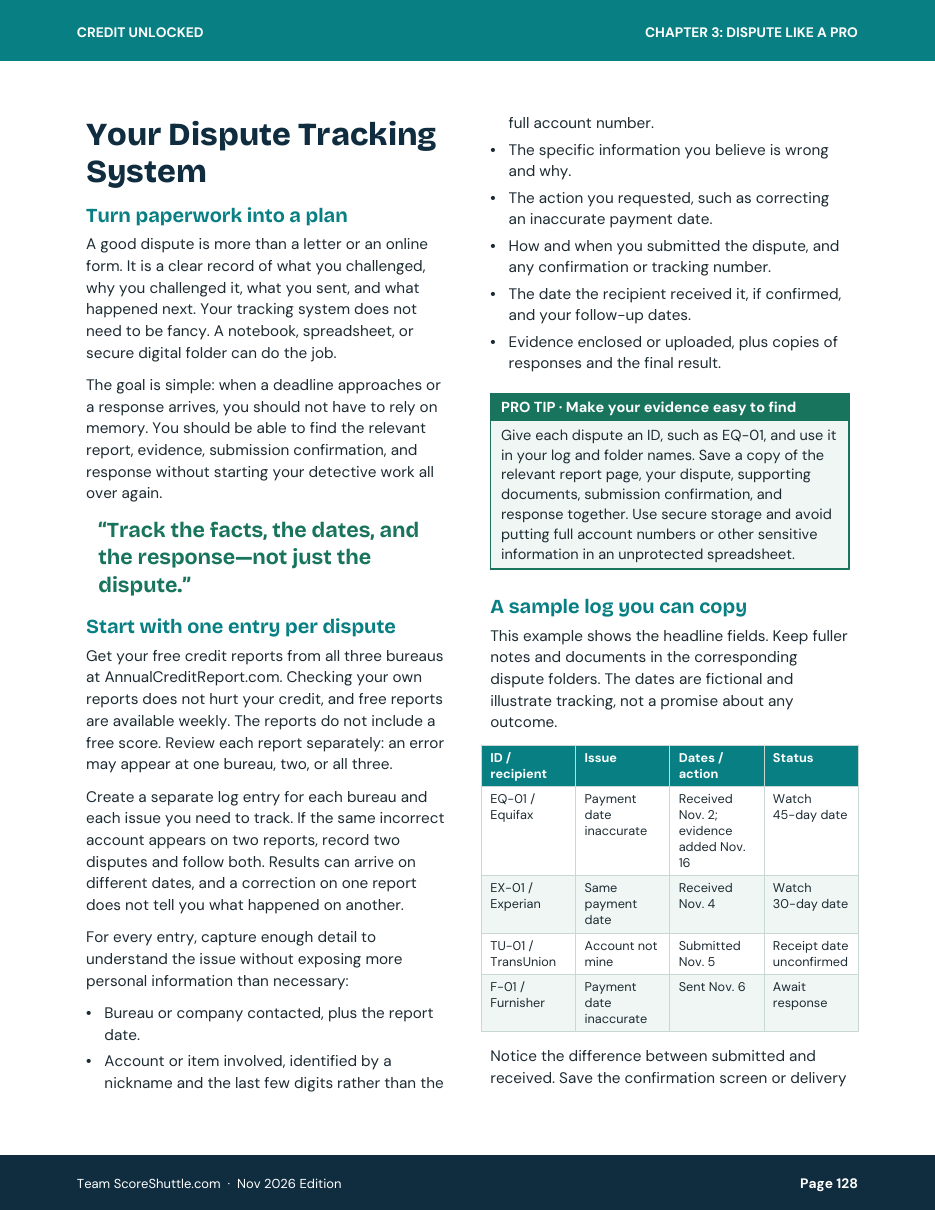
Log the date sent, date received, disputed entry, evidence and response. Read the investigation result carefully and compare any updated report with your original. The CFPB says furnishers generally must investigate and respond within 30 days of receiving a dispute; this is not a promise that your report will change within that period.
If the response does not resolve your concern
Review the reason given. If relevant evidence was missing, send a focused follow-up explaining what it adds. Do not repeatedly send generic disputes without identifying an actual issue; the CFPB notes that disputes reasonably considered frivolous or irrelevant may not be investigated.
If the furnisher finds the information accurate, you can ask the credit reporting companies to include a statement explaining the dispute in your file. For an unresolved credit reporting problem, review the current eligibility and submission instructions at the CFPB complaint page. A complaint is not a guarantee of correction. Consider qualified legal help if the issue is serious or involves a lawsuit.
See the free six-page Credit Unlocked sample
Preview actual ebook pages, including a dispute letter and the tracking system, before deciding whether the full guide is useful to you.
Read the free six-page sampleEnter your email to open the sample. Marketing emails are a separate, optional choice—the sample is free without opting in.
Sources and important limits
- CFPB: How do I dispute an error on my credit report?
- AnnualCreditReport.com: official free credit reports
- IdentityTheft.gov: reporting and recovering from identity theft
General U.S. consumer education, not individualized legal or financial advice. Dispute only information you believe is inaccurate or incomplete. Accurate negative information is not automatically removable. No deletion, score increase, lending approval or outcome is guaranteed. You do not need to buy the ebook or enroll in a service to exercise your dispute rights.