
How to identify genuine credit report errors
An entry that worries you deserves a closer look—but a negative entry is not automatically a mistake. Compare the report with your records before deciding what to dispute.
A genuine credit report error is information you have reason to believe is inaccurate or incomplete: an account that is not yours, a payment status contradicted by your records, or an incorrect balance, for example. Your goal is accurate reporting, not removal of truthful information. Checking and disputing your own reports does not require buying a book or a service.
Start with the reports, not just a score
Get your Equifax, Experian and TransUnion reports through AnnualCreditReport.com, the official free-report site. The CFPB says you can currently request and review your data weekly. A score alone cannot tell you which account or field needs investigation.
Save a dated copy of each report. Check them separately: an issue may appear on only one company’s report. Record the account name, masked account number and the date the entry was last updated. Compare equivalent reporting dates where possible rather than assuming every difference between reports proves an error.
A checklist of common credit report errors
The CFPB’s common-errors checklist groups problems into identity, account-status and data-management errors. Work through these categories one account at a time.
1. Identity and accounts that are not yours
- Incorrect identifying details: a wrong name, address or telephone number. An old address you actually used is different from an address you have never used.
- A mixed file: another person’s account appears on your report, sometimes because you have similar names.
- A possible identity-theft account: credit opened without your permission. Check your records first, but do not ignore an account you cannot explain.
An unfamiliar company name can also be a lender’s legal name, a store-card issuer or a debt collector. Verify it through official account records or the company’s verified contact details. Do not give sensitive information to an unsolicited caller who says they can “fix” your report.
2. Incorrect account status or payment history
- A closed account shown as open.
- An account showing you as the owner when you are only an authorized user.
- A payment incorrectly listed as late or delinquent.
- An incorrect opening date, last-payment date or date of first delinquency.
- The same debt listed more than once in a way that appears to duplicate the obligation.
For a possible duplicate, compare account numbers, balances, ownership and status. A creditor entry and a collector entry are not, by themselves, proof of an error; investigate what each entry actually reports. A recent closure may also need to be checked against the report’s update date.
3. Incorrect balance or credit limit
Compare the reported balance and limit with statements covering the relevant period. A balance that differs from your banking app today is a reason to check dates, not immediate proof of inaccuracy. Look for a mismatch that remains unexplained after comparing the report’s update date with your statements and payment records.
What may be accurate—even when it hurts
A late payment you actually made, an unpaid balance you actually owe, or an account you closed that remains in your history is not automatically an error. “Closed” and “deleted” are different things. Likewise, paying a debt is not a promise that its history will disappear.
A lower score, a denied application or a difference between scores does not identify a reporting mistake. Focus on a specific factual field you can explain. Do not claim identity theft or deny ownership of a debt you recognize simply to challenge a negative entry.
Turn a suspicion into a specific, evidence-based concern
- Quote the field: write down exactly what the report says and which reporting company shows it.
- Compare dated records: use statements, payment receipts, closure confirmations, account agreements or relevant correspondence.
- Describe the mismatch: explain what you believe the accurate information should be and why.
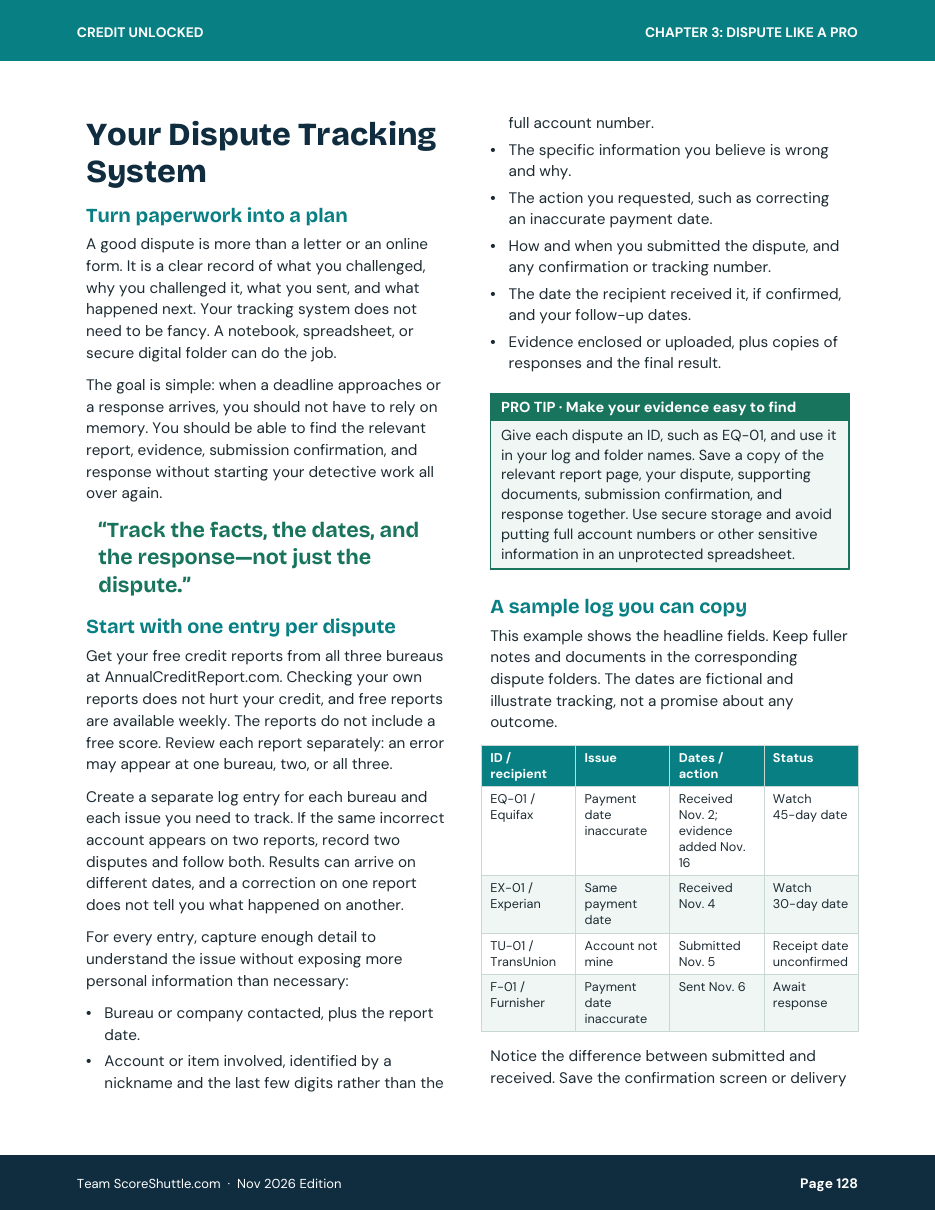
- Keep a record: save the original report, copies of the evidence, and your questions or correspondence.
Example: a possible incorrect late payment
Your report says a payment was 30 days late. Your statement shows the due date, and the lender’s confirmation shows receipt by that date. Compare the account and month carefully. A bank withdrawal alone may not establish when the lender received or credited the payment.
A focused explanation would be: “The report lists [month/year] as 30 days late. My enclosed statement and lender confirmation show a due date of [date] and receipt on [date]. Please investigate and correct the status to reflect the records.” Use this only if it matches your truthful facts.
If you cannot yet explain a mismatch, ask the lender or reporting company for clarification rather than inventing an explanation. Send copies, not your only originals, and use official dispute channels for sensitive account or identity documents.
What to do when you identify a possible error
The CFPB recommends contacting both the credit reporting company and the company that supplied the information, known as the furnisher. Identify the exact item, explain why you believe it is wrong and include relevant supporting copies. Save submission and delivery confirmations, then compare the investigation results with your records.
Use our credit dispute letter guide for a factual example, an evidence checklist and instructions for sending and following up on a dispute. You can dispute errors yourself for free; mailing costs, if you choose postal mail, are separate.
If the account may involve identity theft
Visit the FTC’s IdentityTheft.gov to report identity theft and create a recovery plan. An identity-theft situation may require additional steps beyond an ordinary reporting-error dispute. Do not treat a generic letter as a complete recovery plan.
If the issue remains unresolved
Read the explanation, check whether the relevant evidence was considered, and keep a dated record of responses. Review the current instructions at the CFPB complaint page if you are considering a complaint. For serious harm, mixed-file problems or a lawsuit, consider qualified legal help. Neither a dispute nor a complaint guarantees a correction or a particular score outcome.
Get the free six-page Credit Unlocked sample
Preview actual ebook pages, including a dispute letter and the tracking system, before deciding whether the complete book is useful to you.
Read the free six-page sampleEnter your email to open the sample. Marketing consent is separate and optional; you can get the sample without opting in.
Sources and important limits
- CFPB: Common credit report errors
- CFPB: When to review your credit report
- CFPB: How to dispute an error
- AnnualCreditReport.com: Official free reports
- FTC: Identity theft reporting and recovery
General U.S. consumer education, not individualized legal or financial advice. Dispute only information you believe is inaccurate or incomplete. No removal, score increase, lending approval or outcome is promised. Optional ScoreShuttle services are separate purchases and are not needed to exercise your rights.